
Board games and teamwork can look completely different from one table to the next. In Codenames, you may agonise over one perfect clue. In The Mind, the challenge is to play together without saying anything at all.
Yet both situations are about communication.
Communication around a game table is not simply about talking more. Sometimes it means choosing exactly the right word. Sometimes it means listening carefully, understanding another person’s perspective, sharing only the information you are allowed to share, or deciding that the most useful thing you can do is stay quiet.
Different games put different parts of communication under pressure — and that is where the fun begins.
Communication and teamwork are just two of the abilities explored in our Skills Through Play guide to what you can learn through board games. You can also discover all the games featured here, along with many others, in the GameOn Board Games Library.
Communication is not just about saying more
Take Codenames. One player, the Spymaster, knows which words belong to their team. Everyone else does not. The Spymaster must give a one-word clue and a number that points teammates towards the right words without steering them towards the opposition — or the assassin.
Suppose the words you want your team to guess are snow and penguin. “Cold: 2” might seem obvious. But what if ice or winter is also sitting on the table?
A good clue-giver has to think about both the words and the people receiving the clue. What associations are they likely to make? What might they misunderstand?
That is communication from both directions: expressing an idea precisely and interpreting what somebody else probably meant. It also involves many of the same choices explored in critical thinking and decision-making through board games: considering alternatives, anticipating possible reactions and deciding which option carries the least risk.
Dixit turns that challenge sideways. A storyteller gives a clue for a surreal illustrated card. The clue needs to lead some players to the correct card, but not everybody. If it is too obvious or too obscure, it misses the mark.
The question becomes: “How will these particular people interpret this image?”
A clue that makes perfect sense to your best friend may mean nothing to somebody else. Dixit keeps revealing how differently people can understand the same word, picture or idea. Perspective matters just as much as vocabulary.
That ability to make unexpected connections and imagine how something might be interpreted differently also connects naturally with creativity and flexible thinking through board games.
What happens when you cannot simply explain yourself?
Then there is The Mind.
Players must place numbered cards in ascending order, but they cannot reveal their numbers or communicate information about the cards they hold. Secret signals are also forbidden. You cannot simply announce, “Mine is low, so let me go first.”
Players wait. Someone looks ready to play a card, then stops. Another person holds back a fraction longer.
The challenge is not about inventing clever gestures. Instead, the group has to find a shared sense of timing while everybody works with incomplete information.
The Crew: Mission Deep Sea creates a very different form of restricted communication.
Players cooperate to complete trick-taking missions, but they cannot freely reveal or discuss the cards in their hands. The game instead provides sonar tokens that allow a player to communicate limited information about a card — for example, that it is their highest, lowest or only card of that colour.
Suddenly the questions change.
What does my team actually need to know? Is this the right moment to share it? What might another player be trying to achieve?
Good communication is not always about giving more information. Sometimes it is about relevance, timing and restraint.
Working out what other players know, connecting limited pieces of information and adjusting when a plan starts going wrong also overlap with the challenges explored in problem-solving, logic and deduction through board games.
Persuasion, disagreement and reading the group
Werewolf could hardly feel more different.
Players have hidden roles. The village is trying to identify the werewolves, while the werewolves are trying to survive suspicion. Discussion, accusation, defence and voting become part of the game itself.
“I think it’s you.”
“Why me?”
“Because you changed your story.”
Here, communication is not about finding one perfect clue. It is about making a case, listening for inconsistencies, responding to accusations and deciding whose argument you trust.
Two people may interpret exactly the same behaviour differently, yet the group still has to reach a decision.
Werewolf therefore creates repeated opportunities to persuade, question, listen, defend a position and disagree. Sometimes very loudly.
That does not mean the game scientifically makes somebody a better communicator. It simply means those behaviours are built directly into what players have to do.
Teamwork needs a shared problem
Not every group of people sitting at the same table is actually collaborating.
The Education Endowment Foundation’s guidance on collaborative learning describes collaborative learning as people working together on activities where everyone participates in a collective task. Its guidance also stresses that effective collaboration needs carefully designed tasks rather than simply putting people into groups.
That distinction fits cooperative board games particularly well.
In The Crew, everyone succeeds or fails together. Nobody can complete the mission alone because the cards and information are spread across the team. Players have to coordinate separate actions towards one result.
Even a competitive team game such as Codenames gives each team a shared problem: understand the clue, compare possible interpretations and decide which word to choose.
The game gives teamwork something concrete to focus on. There is a card to interpret, a clue to discuss, a vote to make or a mission to complete.
The conversation has a purpose.
The social side of the physical table
Sitting around the same physical table adds another layer.
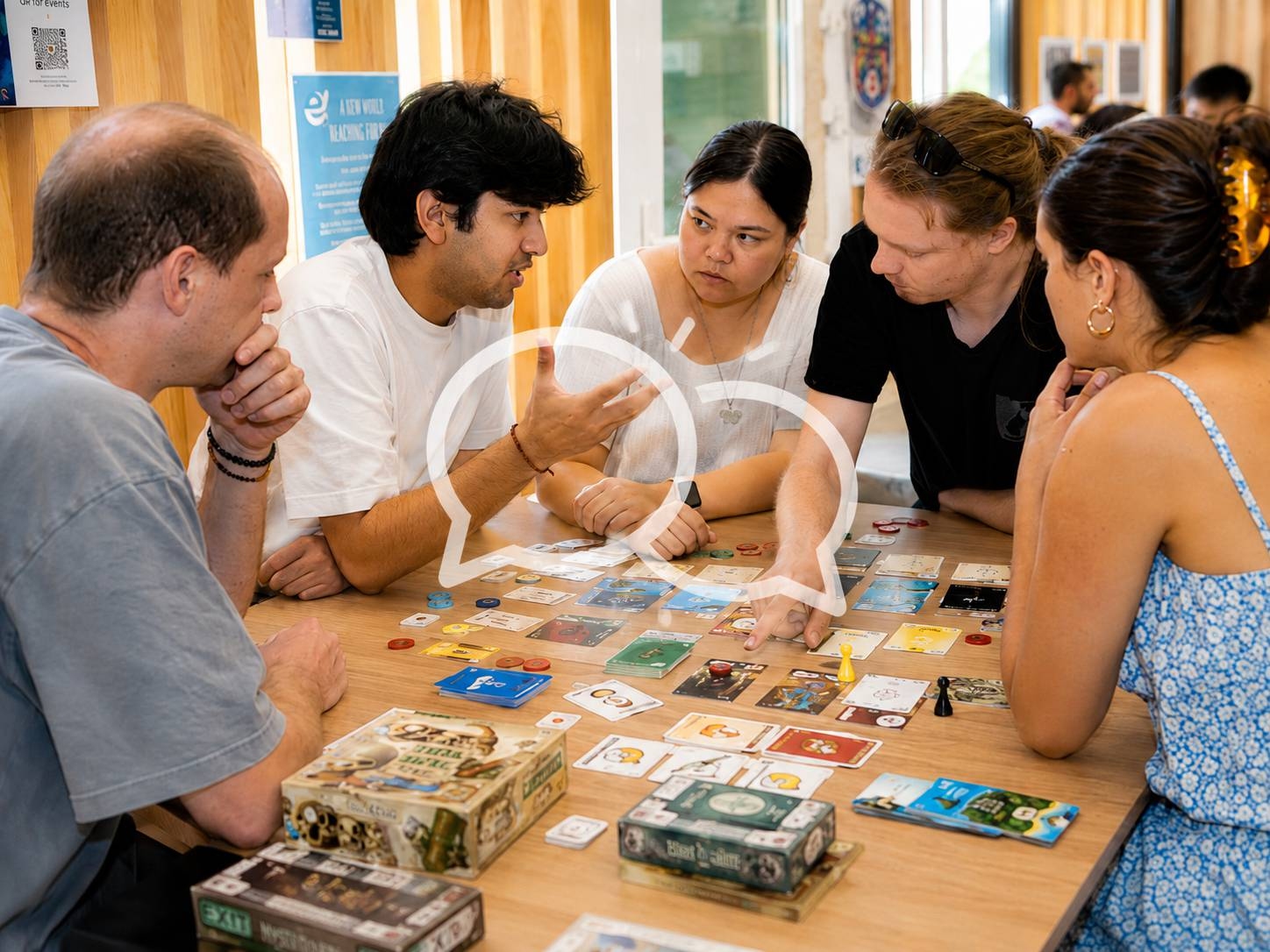
Everyone can see the same game state. Reactions are immediate. A raised eyebrow, a long silence, somebody suddenly changing their mind or a burst of laughter all become part of the shared experience.
Nobody has to invent a topic of conversation because the game is already giving the group something to respond to.
That does not mean every board game will make every group communicate brilliantly. Research into board-game interventions covers very different games, settings and outcomes, so broad claims should be treated cautiously. A systematic review of board-game interventions found promising results across several areas while also highlighting how varied the existing research is.
A more useful observation is much simpler: certain games repeatedly put players into situations where communication and collaboration are necessary parts of playing.
This is also one reason communication and teamwork form part of the wider GameOn approach. The original GameChangers project specifically included activities intended to encourage social interaction, communication and teamwork alongside critical thinking, problem-solving and creativity.
Notice what happens between the turns
The next time you play, watch the moments between the official moves.
Who explains an idea so everyone understands it?
Who changes their mind after hearing a better argument?
Who gives too much information?
Who notices what somebody else is trying to achieve?
Who manages to communicate something useful with very little?
Codenames asks you to be precise.
Dixit asks you to think about interpretation.
The Mind takes ordinary conversation away.
The Crew: Mission Deep Sea strictly limits what you can reveal.
Werewolf puts persuasion, listening and disagreement right in the centre of the table.
Different games. Different communication challenges.
And that is why board games and teamwork are about much more than talking. They are also about how clearly we communicate, how carefully we listen, how well we understand other people — and what we do together with the information we share.
If you would like to explore the other skills that can appear around the game table, continue through our Skills Through Play series with critical thinking and decision-making, problem-solving and logic and creativity and flexible thinking — or browse the complete GameOn Board Games Library to find your next game.