
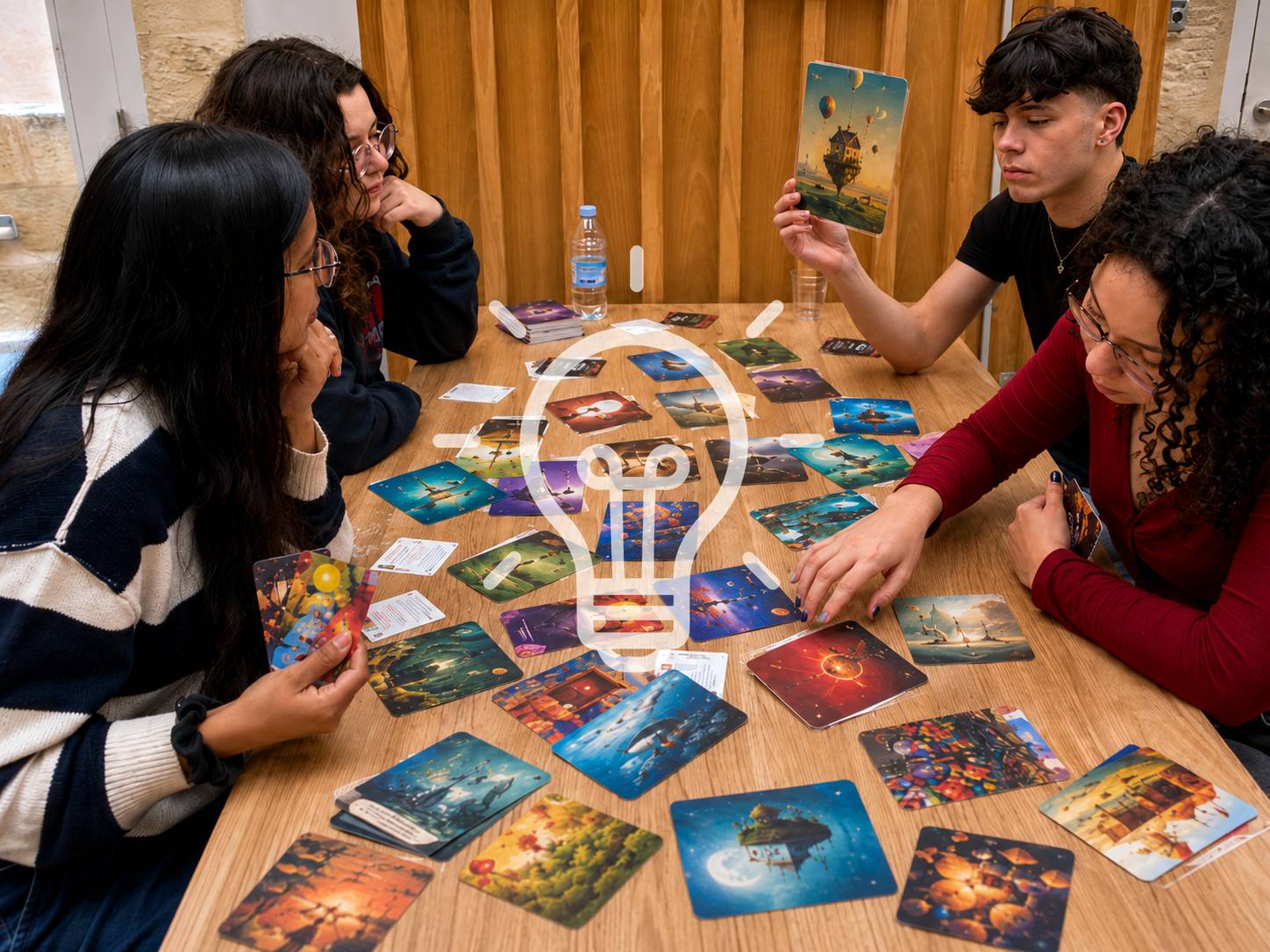
Three people look at the same strange Dixit card. One sees loneliness. Another sees freedom. A third somehow sees their grandmother’s kitchen.
Nobody is necessarily wrong.
That small moment captures something important about board games and creativity: creativity is not only about drawing a picture or inventing a story. It can mean making an unusual connection, imagining several possibilities, finding another route when the obvious one fails, or expressing an idea in a way somebody else has to decode.
The OECD’s PISA creative thinking framework takes a similarly broad view. It looks at the ability to generate diverse and original ideas, as well as evaluate and improve them, across areas including communication and problem-solving.
Board games cannot guarantee that somebody will “become more creative”. What they can do is create repeated, low-pressure opportunities to try creative behaviours while the main goal is simply to play.
That is part of the wider idea behind Skills Through Play: different games present different challenges, and therefore invite different kinds of thinking around the table.
Seeing what somebody else sees: Dixit
In Dixit, one player chooses a surreal illustrated card and gives the group a clue. It might be a word, a phrase, a sound or something more unexpected. The other players then choose cards that could plausibly fit the same clue.
The interesting part is that the clue cannot simply describe what is visible. If it is too obvious, the challenge disappears. If it is so obscure that nobody follows the connection, it does not work either.
So you start asking different questions. What does this image remind me of? What feeling does it create? Is there a film, memory, joke or metaphor hidden in it? Most importantly: how might the other people around this table interpret what I say?
That is creative thinking mixed with communication. The same picture can lead to several valid interpretations, and players get an immediate demonstration that other minds do not always travel along the same path. It is also a good example of how board games create opportunities to practise communication and listening skills without turning the experience into a formal exercise.
Connecting ideas that do not seem connected: Codenames
Now swap dreamlike pictures for a grid of words.
In Codenames, the clue-giver tries to connect several target words using a single-word clue. Suddenly, ordinary words become a search for an invisible bridge between ideas.
You may stare at three apparently unrelated words for thirty seconds, reject the obvious clue, try another connection, realise it accidentally points towards the wrong card, and start again.
This is a very different kind of creativity from Dixit. You are not creating a story. You are forming associations under tight restrictions and trying to predict how somebody else will follow them.
It also connects naturally with communication skills through board games: the cleverest clue in your own head is useless if your teammates interpret it in a completely different way.
Combining pieces into something new: Canvas
Canvas is the most obviously artistic game in this group, but even here the useful idea is bigger than “being good at art”.
Players layer transparent cards to build paintings while also trying to satisfy scoring conditions. A card that looks perfect on its own may be less useful when combined with the other layers. Another combination may produce something unexpected — visually, strategically, or both.
That creates a familiar creative challenge: work with what you have.
Instead of starting with a blank page and unlimited possibilities, you are selecting, combining and rearranging existing elements. Designers, writers, entrepreneurs and problem-solvers do this constantly. New ideas often come from recombining familiar pieces in ways that were not obvious at the start.
And because the available cards change, players may have to let go of their first idea and build something different.
That ability to reconsider an initial plan also connects creativity with critical thinking and decision-making through board games. Sometimes the creative idea is not your first idea. It appears when you realise the first one no longer works.
Asking the question nobody else has asked: Black Stories
A man is dead. A strange detail makes no sense. One player knows what really happened. Everyone else can only ask questions that can be answered with yes or no.
Welcome to Black Stories.
At first, groups often ask sensible questions based on the most obvious explanation. Then the answers keep being “no”. Eventually somebody asks something that sounds ridiculous — and suddenly the whole mystery shifts.
That moment is lateral thinking in action.
Players have to imagine possibilities, test them, discard assumptions and change direction. The game rewards curiosity rather than simply knowing facts. Sometimes progress comes from asking a more precise question. At other times, it comes from questioning the story everyone at the table has silently assumed must be true.
That overlaps with problem-solving through board games, but the creative part lies in generating alternative explanations before logic can test which one fits.
Creating inside limits: Fit to Print
Creativity is often imagined as total freedom. Games provide almost the opposite: rules, limited resources, restricted actions and sometimes a ticking clock.
Fit to Print turns those limits into the challenge. Players gather newspaper pieces and then race to arrange articles, photographs and advertisements into a coherent front page. You cannot use everything. Space matters. Placement matters. Time matters.
So you improvise.
Perhaps the layout you imagined no longer fits. Perhaps you have too much of one type of content. Perhaps your beautiful plan leaves an awkward gap. The job becomes finding the best available solution rather than waiting for the perfect one.
Interestingly, research on creativity and constraints suggests the relationship is more nuanced than “freedom is good, rules are bad”. Certain constraints can focus the search for ideas and encourage different solutions, although too many restrictions can also get in the way.
That is one reason games can be such interesting creative spaces. The rules create the problem; the player looks for possibilities inside it.
Creativity is not one skill
Put these games side by side and “being creative” starts to look much broader.
Dixit asks you to interpret. Codenames asks you to connect. Canvas asks you to combine. Black Stories asks you to question assumptions. Fit to Print asks you to adapt and create within limits.
None of those games proves that playing will permanently increase someone’s creativity. However, each creates moments where players practise behaviours associated with creative thinking: generating alternatives, making connections, imagining possibilities, communicating indirectly and changing approach when an idea does not work.
Those skills often overlap. A strange Codenames clue combines creativity with communication. A Black Stories theory combines imagination with problem-solving. Changing your plan in Canvas or Fit to Print can require both creativity and critical thinking. That is exactly why the different articles in our Skills Through Play series connect so naturally: real gameplay rarely uses just one skill at a time.
Better still, those moments rarely feel like exercises.
They feel like trying to make your friend understand an impossible clue, discovering that everyone saw a picture differently, laughing at a bizarre theory that turns out to be useful, or rebuilding your entire plan with seconds left.
That is the strength of learning through play. Sometimes thinking differently begins because the game leaves you no other choice.
Want to try some for yourself? Explore the Game On Board Games Library and discover games that challenge communication, problem-solving, critical thinking and creativity in very different ways.