
There is a familiar moment in almost every game night. You have a plan, it is going perfectly, and then somebody takes the route, tile or card you needed. Suddenly you have to rethink everything. A few turns later, you may be decoding a clue that makes sense only in somebody else’s head, bluffing with a straight face, or watching victory disappear by a single point.
When people talk about the skills you can learn through board games, this is often what they mean in practice. Games create repeated opportunities to make decisions, solve problems, communicate, adapt and manage emotions — all while you are focused on something much simpler: trying to win, help your team or solve the mystery.
That does not mean every board game automatically makes us smarter, more creative or better communicators. Research is more nuanced. A 2023 systematic review of analogue game-based learning found evidence of a broad range of cognitive, psychological and soft-skill outcomes, while also highlighting limitations in the research. A better way to think about games is as spaces where particular skills are required and practised naturally.
Critical thinking and decision-making: “What happens if I do this?”
Board games are full of small decisions with consequences.
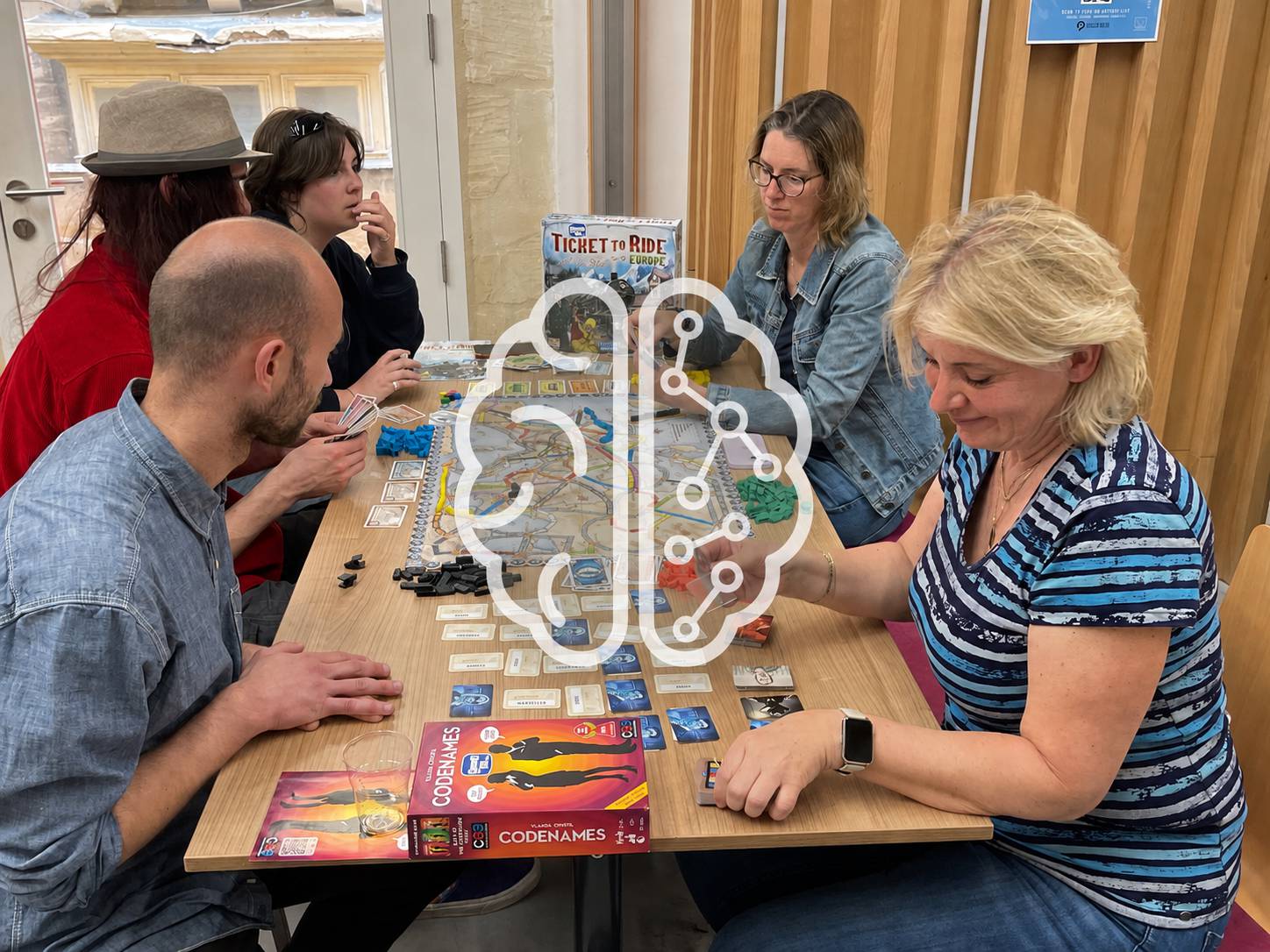
In Ticket to Ride, you might be collecting cards for the perfect route when another player suddenly claims the connection you needed. Do you take a longer route, abandon one destination, or spend precious turns rebuilding your plan?
Azul creates a different kind of pressure. The attractive choice in front of you is not always the best one once you consider scoring, penalties and what you may leave for another player. Coup adds bluffing: you also have to judge whether someone is likely to challenge you.
These moments ask players to compare options, weigh risk and reward, anticipate consequences and decide with incomplete information. Sometimes the clever move works. Sometimes it fails spectacularly. Either way, the next decision arrives quickly.
We explore these situations in more detail in Think Before You Move: Critical Thinking and Decision-Making Through Board Games, including what happens when players have to assess risk, anticipate opponents and change plans midway through a game.
Problem-solving and logic: finding a way forward
Some games put the problem directly in front of you and almost dare you to solve it.
Unlock! Epic Adventures turns the table into an escape room. Players search for connections between clues, test ideas and reconsider assumptions when a solution goes nowhere. The Crew: Mission Deep Sea creates a different puzzle. The team shares a goal, but communication is restricted, so players must work out how to complete specific card-playing missions without simply revealing everything they hold.
A puzzle rarely disappears because the first idea failed. Instead, players ask: What have we missed? What information do we actually have? Is there another interpretation?
Games also give fast feedback. A theory opens the next clue, or it does not. A plan completes the mission, or everyone realises exactly where it went wrong.
That process of noticing clues, testing possibilities and trying another approach is at the heart of problem-solving through board games.
Communication and teamwork: saying enough, but not too much
Good communication is not always about talking more. Sometimes it is about choosing the right information.
Codenames is a perfect example. The clue-giver has one word to connect several ideas without accidentally sending the team towards the wrong cards. Teammates then have to listen, interpret and sometimes disagree about what that clue really means.
The Mind goes even further: players cooperate without speaking. Suddenly pauses, timing and attention to other people become part of the game.
Cooperative games such as The Crew: Mission Deep Sea also show that teamwork is not simply “being nice”. Teams need shared plans, trust, patience and the ability to recover when somebody misunderstands the situation.
Around a game table, those skills are not abstract. They are happening in real time. In Talk, Listen, Work Together: Communication and Teamwork Through Board Games, we look more closely at how games make players explain, listen, interpret and coordinate with other people.
Creativity and flexible thinking: when the obvious answer is not enough
Dixit is built around the gap between what you see and what somebody else sees.
A picture might remind one person of a film, another of a childhood memory and somebody else of a ridiculous joke. The storyteller has to give a clue that is understandable — but not so obvious that everybody guesses it. That encourages unusual connections, storytelling and perspective-taking without turning creativity into a formal exercise.
Flexible thinking also appears in less obviously creative games. UNO Flip can change the state of the game in seconds. A comfortable hand can become a problem, and the strategy you were using may suddenly be useless.
That ability to adapt is part of play. The board changes. Other people interfere. Luck refuses to cooperate. So you try something else.
Creativity around the game table is therefore much broader than drawing or storytelling. It can mean finding unusual connections, improvising, changing strategy or seeing more than one possible solution. We explore those different forms of thinking in Think Differently: How Board Games Spark Creativity and Imagination.
Social and emotional skills: winning, losing and carrying on
Then there is the part of board games that every competitive family understands: feelings.
You can play brilliantly and still draw the Exploding Kitten. You can build a strong Sushi Go Party combination and lose by one point. In Werewolf, you might make a convincing argument and still get voted out.
Games create relatively low-stakes moments of frustration, uncertainty, excitement and disappointment. Players wait for turns, follow shared rules, cope with setbacks and discover that losing a round is survivable.
They also create positive moments: laughing at a terrible bluff, celebrating a teammate’s clever move, helping a new player with the rules, or discovering that the quietest person at the table has just outsmarted everyone.
Research does not justify saying that one evening of games automatically creates resilience or emotional intelligence. However, games can create situations where patience, self-control, perspective-taking and dealing with winning and losing are genuinely needed.
Those moments are the focus of Winning Isn’t Everything: The Social and Emotional Skills We Practise Through Games, where we look at patience, frustration, resilience, empathy, fair play and what happens when the result does not go your way.
Why board games work so well as practice spaces
Perhaps the biggest advantage is that none of this feels like a worksheet.
The goal is immediate. Other people react to what you do. The situation changes. You make another choice.
That fits the broader idea of learning through experience. The OECD Learning Compass places importance on competencies involving knowledge, skills, attitudes and values, as well as agency and the ability to navigate unfamiliar situations. Board games are not a replacement for education or real-world experience. They are simply one enjoyable environment where many of those behaviours can appear naturally.
Different games also demand different things. A deduction game may reward careful reasoning. A party game may depend on reading people. A cooperative game may force a group to coordinate. A strategy game may punish you for focusing only on the present turn.
That variety is exactly why there is no single “best board game for skills”.
Start with the game, and the skills follow
The easiest way to experience this is not to announce that everyone is about to practise critical thinking.
Pick a game that looks fun.
Build the railway. Decode the clue. Escape the room. Bluff your way through the round. Make somebody understand a wonderfully strange Dixit card. Lose by one point, complain about it for thirty seconds, then ask for a rematch.
The Game On Board Games Library includes games for different ages, group sizes and styles of play, from quick card games to cooperative mysteries and deeper strategy games. Explore the library, choose something that appeals to your group and see what starts happening around the table.
Because sometimes the most useful skills are being practised while everyone thinks they are just playing.