
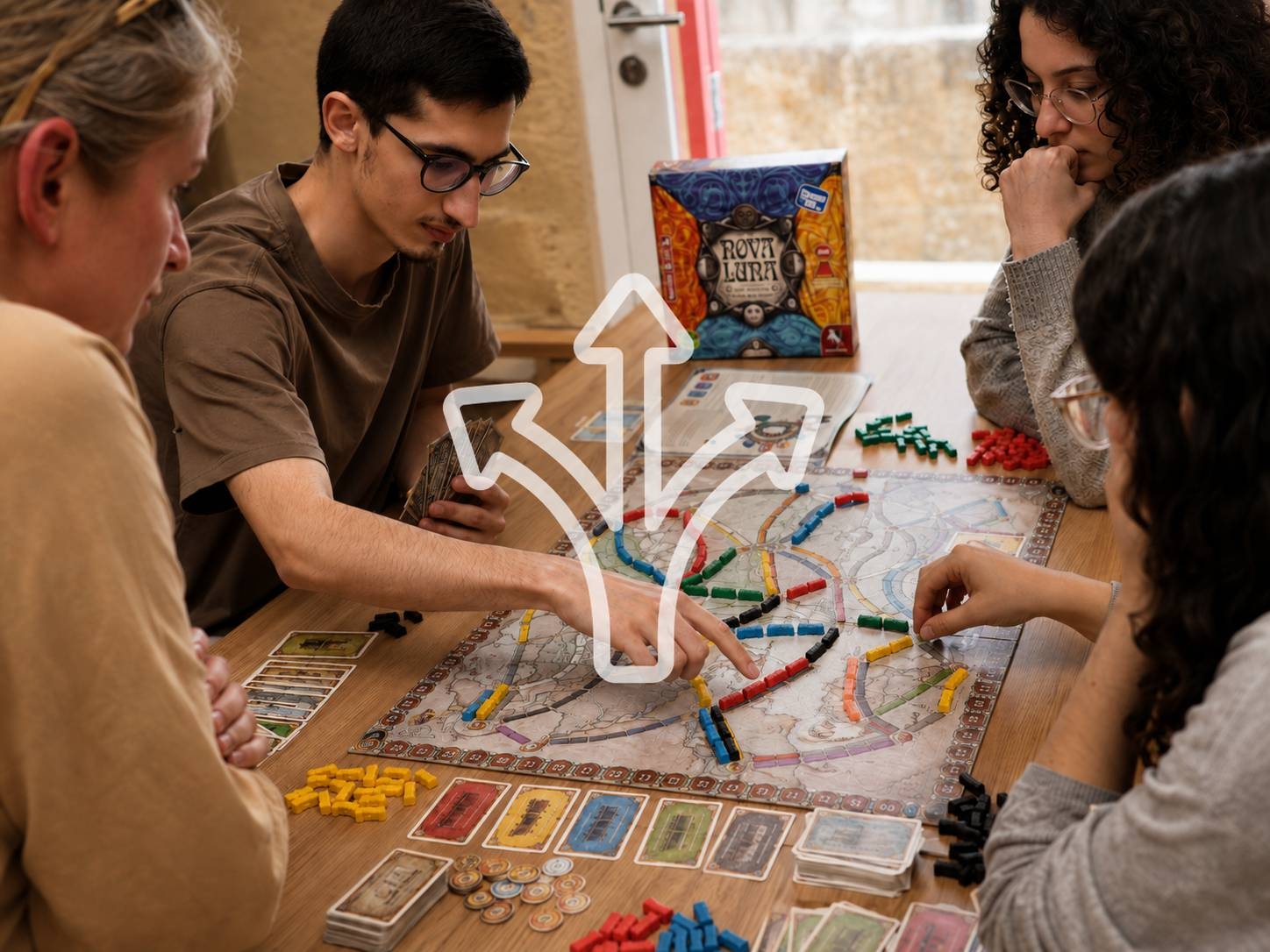
Should you take that route now or risk waiting another turn? Pick the tiles you really need, or stop someone else getting them? Keep exploring for more treasure, or leave before everything goes wrong?
This is where board games and critical thinking naturally meet. Players are constantly making small decisions: comparing options, looking for clues, judging risk, anticipating what others might do and changing plans when the situation changes.
Critical thinking is only one part of the bigger picture. Board games can also create opportunities to practise problem-solving and observation, communication and teamwork, creativity and flexible thinking and social and emotional skills. You can explore the wider picture in our guide to skills through board games.
You rarely sit at a game table thinking, “I am practising decision-making.” You are simply trying to win, survive, score another ten points or avoid collecting a terrible row of cards.
Yet the decisions are very real.
What does critical thinking look like during a game?
Critical thinking does not have to mean solving an elaborate logic puzzle.
Sometimes it is simply stopping for a moment and asking:
What are my options? What could happen next? What information do I have? What am I assuming? Is my original plan still the best one?
Different games make players ask these questions in very different ways.
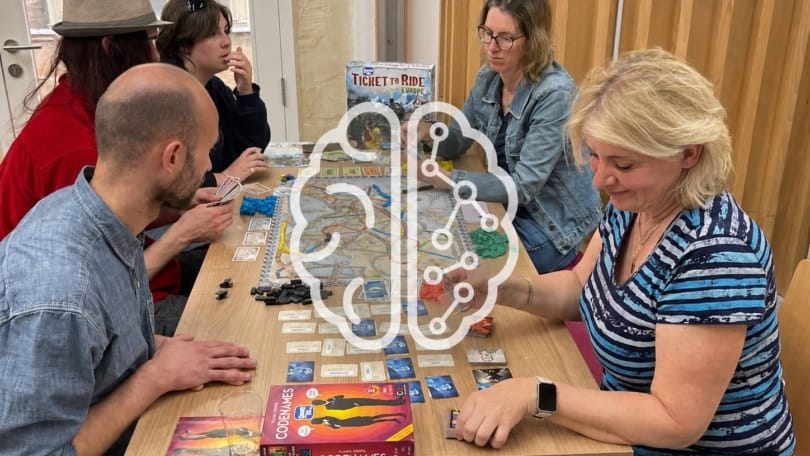
Ticket to Ride: When should you commit to a plan?
In Ticket to Ride, players collect matching train cards and use them to claim railway routes between cities while trying to complete destination tickets.
Imagine that one short section of track is important to your route.
You have enough cards to claim it now. However, another colour you need has just appeared in the card display.
Do you take the cards and hope the route remains available?
Or do you secure the route immediately?
Now add another player who appears to be building in the same direction.
Suddenly, you are weighing several things at once: your long-term objective, your current resources, what another player might be planning and the cost of being wrong.
Even a good original plan may need to change. If somebody takes the connection you wanted, complaining about it will not reconnect your railway. You need another route.
That makes Ticket to Ride a useful example of planning ahead while remaining flexible.
This ability to change approach when the obvious solution disappears also overlaps with the kind of problem-solving through board games explored elsewhere in this series.
Azul: The best move for you can change what happens next
Azul presents a different problem. Players draft coloured tiles from shared displays to build patterns on their own boards. The tiles you take affect what remains available to everyone else, while taking more than you can place can also create penalties.
Suppose you need three blue tiles. Four are available.
Taking them helps your mosaic, but what happens to the extra tile? Could it cause a penalty?
Meanwhile, another player clearly needs yellow.
Should you concentrate entirely on your own board, or choose tiles that also make their next turn more difficult?
The interesting part is that there often is not one obviously “correct” answer. Players have to prioritise competing goals: scoring now, preparing future rows, avoiding penalties and paying attention to what other people need.
A decision that looks excellent in isolation may look very different once you consider the whole table.
Sushi Go Party: Choose now with only part of the picture
In Sushi Go Party, everyone chooses a card from their hand and passes the remaining cards to the next player. Different sushi combinations score in different ways, so every pick involves deciding what is most valuable right now and what may still be available later.
Perhaps you already have two cards from a useful set.
Do you grab the third immediately?
Or is there another valuable card that you are unlikely to see again?
You can also look at what other players have collected. If three people are chasing the same type of card, your original scoring plan may suddenly become much harder to complete.
This is decision-making with incomplete information. You know some things, can infer others and simply have to accept that part of the situation remains uncertain.
That is an important distinction: good decision-making does not always mean knowing exactly what will happen.
Take 6!: What will everyone else choose?
Take 6! (6 nimmt!) turns uncertainty into the main challenge. Players secretly select numbered cards at the same time. Once revealed, the cards are added to four rows according to fixed rules. Play the sixth card in a row and you collect the first five — along with their penalty points.
You may look at the table and think your 74 is perfectly safe.
But what if someone else plays 71?
And someone else plays 72?
Your safe option can become dangerous before your card even reaches the table.
So the question becomes: Which choice is safest considering what everybody else might do?
You cannot know their cards. Instead, you assess the visible situation, remember what has already happened and choose a level of risk you are willing to accept.
Sometimes you calculate carefully and still collect a horrible row.
That does not automatically mean the decision was bad. A sensible decision can still produce a bad result when information is incomplete.
Critical thinking is also knowing when to doubt your assumptions
Coup takes decision-making away from maps and numbers and puts it into people.
Players have hidden character cards, but they can claim character abilities whether or not they actually hold that character. Other players can challenge those claims, with influence at stake if the challenge goes badly.
Someone claims to be the Duke.
Are they telling the truth?
More importantly: do you have enough reason to challenge them?
Perhaps they have claimed the same role repeatedly. Perhaps another revealed card makes their claim less convincing. Or perhaps they simply look far too pleased with themselves — which may mean absolutely nothing.
Coup creates repeated moments where players must separate what they know from what they merely suspect.
That is a particularly relatable form of critical thinking: examining the evidence before acting on an assumption.
It also shows how closely thinking and interaction can overlap. Reading another player’s behaviour, communicating intentions and interpreting what others are doing are part of the wider communication and teamwork skills practised through games, even when the game itself is competitive.
Risk versus reward in its simplest form: Diamant
Few games make a decision as clear as Diamant.
Players explore a cave and collect treasure. At each stage, they can continue deeper in the hope of finding more or return to camp and secure what they have collected. Encounter the wrong combination of hazards and players who stayed inside can lose their haul from that expedition.
So:
Do I stay or do I leave?
Ten seconds earlier, continuing might have seemed obvious. Then another hazard appears.
The reward has not disappeared, but the risk has changed.
Diamant is useful precisely because the decision is so visible. Players repeatedly reassess the same basic question using new information. They may also notice how their own attitude changes after a lucky escape or a disastrous round.
A bad result is not always a bad decision
Board games also give us something valuable: another attempt.
Your railway gets blocked. Your perfect Azul plan leaves you with penalties. Your “safe” Take 6! card turns into a disaster.
Then the game continues.
That creates a natural opportunity to ask: Was my reasoning poor, or did an uncertain situation simply go against me? What did I overlook? Would I make the same choice again?
Learning to review a decision can be just as interesting as making it.
There is also an emotional side to this. Accepting that a carefully considered move did not work, managing disappointment and carrying on with the game connect with the social and emotional skills we practise through board games.
And sometimes the best response is not to calculate harder, but to find a completely different approach — something we explore further when looking at creativity and flexible thinking through board games.
Do board games actually improve critical thinking?
This is where it is worth being careful.
The games above clearly require players to use processes connected with planning, flexibility, risk assessment and decision-making. That does not automatically prove that playing Ticket to Ride or Azul will make somebody a better decision-maker outside the game.
Research into board games and cognitive skills is promising, but still developing. A 2026 systematic review and meta-analysis found some positive results but concluded that the overall evidence is not yet strong enough to make broad recommendations that board games improve executive functions.
Earlier research, including a 2023 randomised study involving modern board and card games, has reported changes in areas such as cognitive flexibility and inhibition in specific groups. However, those findings should not be turned into promises about every player, every game or automatic transfer to everyday life.
A more useful way to think about it is this: board games create enjoyable situations in which these thinking processes have to be used repeatedly.
And unlike a worksheet asking you to “practise decision-making”, there may be a train route, a pile of treasure or one extremely suspicious Duke at stake.
Put your thinking to the test
The next time you play, pay attention to how often you change your mind.
What made you take a risk? Why did you abandon one plan for another? Did you react to something another player did? Were you working from facts, probabilities or a complete guess?
Those questions are happening around game tables all the time.
If you want to try them yourself, explore the GameOn Board Games Library and choose a game that gives players plenty of meaningful decisions to make.
You can also continue exploring the wider Skills Through Play series to see how games put problem-solving, communication and teamwork, creativity and social and emotional skills into action.
Sometimes the most interesting part of a move is not whether it worked.
It is why you chose it.