
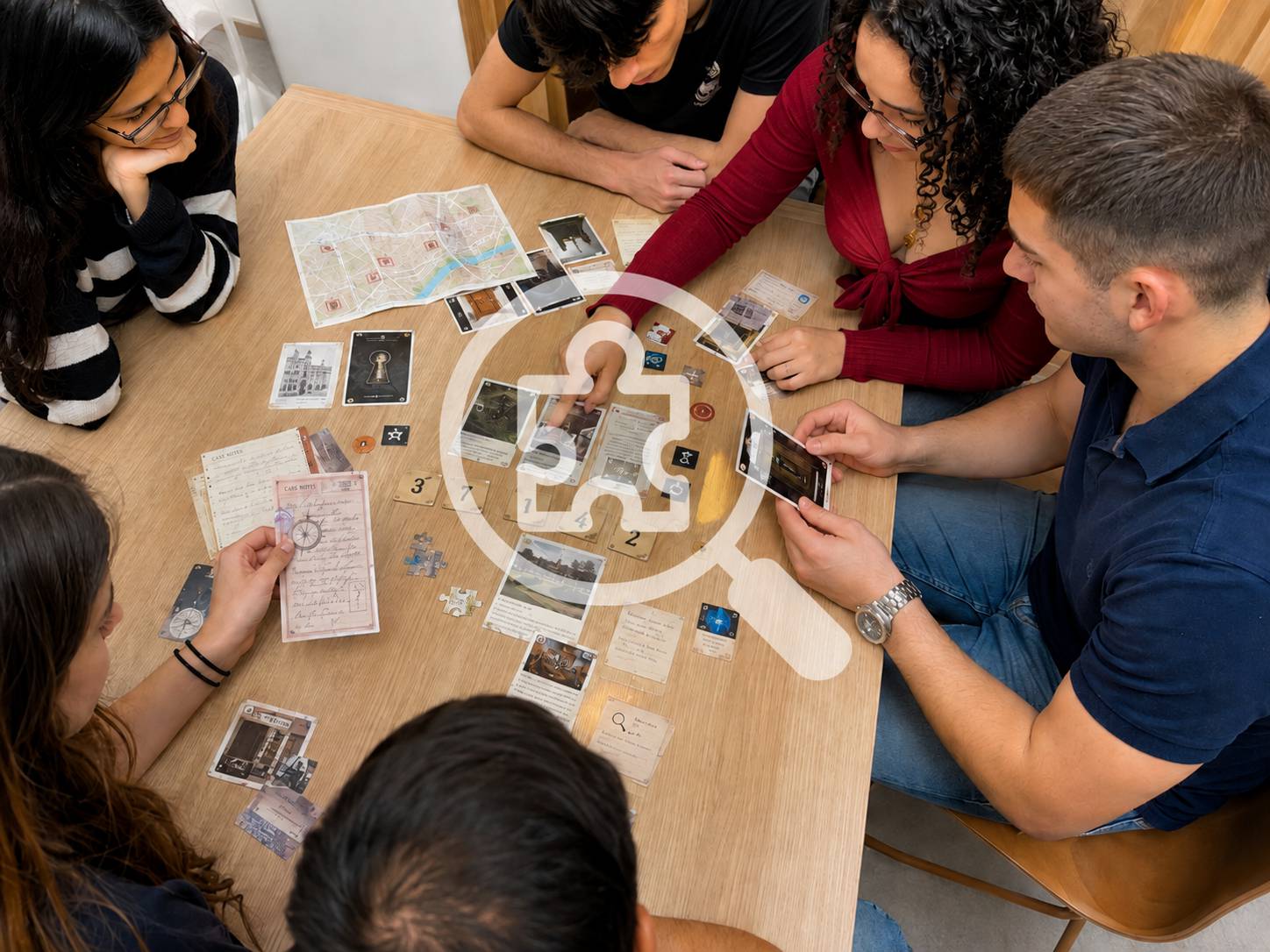
You have been staring at the same clues for ten minutes.
Nothing fits. One theory contradicts another. Someone suggests starting again. Then another player spots something everyone else has overlooked—a tiny detail on a map, a date in a document or a clue that suddenly rules out half your ideas.
Everything changes.
That moment is one reason board games and problem-solving work so naturally together. Many games do not simply ask you to choose between good and bad moves. They give you something that needs to be solved.
You observe. You test an idea. It fails. You look at the problem differently. And sometimes the solution that seemed impossible a few minutes ago suddenly becomes obvious.
Problem-solving is just one of the many abilities that can come into play around the game table. In our wider guide to skills you can practise through board games, we explore how different games create opportunities to use everything from communication and creativity to critical thinking, teamwork and resilience.
Problem-solving is not quite the same as making a good decision
In our article about critical thinking and decision-making through board games, we looked at choices: Should you take this route? Can you afford to wait? What is another player planning?
Problem-solving feels different.
There may be a mystery to unravel, a physical arrangement that has to work, a suspect to eliminate or several apparently unrelated clues that need to connect.
The challenge becomes: What information do I have, what does it tell me, and what am I still missing?
Research supports being a little careful about claiming that simply playing any board game will automatically make someone a better problem-solver. A systematic review of analogue game-based learning found evidence of a broad range of learning, cognitive and psychological outcomes, while also highlighting the importance of game design and context.
Similarly, a review of board games and children’s learning notes that the type of game—and how it is played—matters when considering problem-solving and reasoning.
The interesting part, therefore, is looking at what the game actually asks players to do.
Observation: seeing what everyone else missed
Few games demonstrate this better than MicroMacro: Crime City.
The table is covered by one enormous, highly detailed city map. Somewhere among its streets, buildings and tiny characters is the information needed to solve a case.
Players might need to find someone at one location, then trace that character across the map and work out what happened earlier or later. A person spotted outside a shop may turn up somewhere completely different a few streets away. What looked like background decoration suddenly becomes evidence.
The problem is not solved by knowing a clever fact. It requires looking carefully, recognising connections and reconstructing a sequence from scattered visual information.
One player notices a character. Another spots where that character came from. Someone else connects the two observations.
The solution gradually appears because the group has learnt what to look for.
Deduction: turning what is impossible into an answer
Problem-solving is not always about finding the correct answer directly. Sometimes it is about steadily removing all the answers that cannot be correct.
Cluedo Suspect makes that process very clear.
You are trying to identify the suspect, location and weapon. Every piece of information changes what remains possible.
If another player can show you a particular card, one possibility disappears. If nobody can answer a question, that absence of information may itself become useful. Slowly, the field narrows.
This is deduction in a very practical form: start with many possibilities, collect evidence and eliminate them one by one.
Jump to a conclusion too early and you may be wrong. Keep track of what you know—and just as importantly, what you do not know—and the solution becomes much stronger.
Testing theories: asking better questions
Black Stories approaches the problem from another direction.
Players hear a strange situation but only one person knows the full explanation. Everyone else can uncover it only by asking questions that can be answered with yes or no.
That restriction matters.
“Tell us what happened” will get you nowhere. Instead, you begin testing theories.
Was another person involved? No.
Did the location matter? Yes.
Did the person know what was going to happen? No.
Every answer gives the group a little more structure. A theory may sound brilliant for five minutes before one simple “no” destroys it.
And that is useful.
The failed theory has not wasted your time. It has ruled out one path and given you information for the next attempt. Players have to reconsider their assumptions, ask more precise questions and sometimes approach the entire situation from an unexpected angle.
That willingness to make unexpected connections also overlaps with creative and flexible thinking: sometimes solving the problem means abandoning the obvious explanation and imagining a completely different possibility.
Spatial problem-solving: when the pieces simply will not fit
Not every problem needs words or clues.
Brain Train presents reusable logic challenges in which players arrange trains within grids and work through increasingly difficult spatial puzzles.
Here, your idea gets tested physically.
You place something where you think it belongs. A few moves later, the rest of the puzzle cannot work.
So what now?
You can keep forcing the same solution—or recognise that the failed arrangement has just taught you something. Perhaps one piece cannot start there. Maybe the puzzle needs to be approached from the opposite side. Maybe you need to work backwards from the space that has the fewest possibilities.
That cycle of try, check, learn and adjust is problem-solving in action.
Connecting information: when no single clue is enough
Then there are problems where the difficulty comes from having too much information.
Cold Case: A Pinch of Murder puts documents, photographs, letters and other evidence in front of the players and asks them to investigate a mysterious death.
One document rarely provides the solution.
Instead, the group has to compare information. Does something in one piece of evidence support—or contradict—something found elsewhere? Is a detail important, or simply distracting? Does another player interpret the same clue differently?
This is where collaborative problem-solving becomes particularly interesting.
One person may notice a detail that another dismissed. Someone may challenge the group’s favourite theory. Players explain why they think two pieces of information connect, and the group decides whether the evidence really supports that conclusion.
The puzzle becomes something everyone builds together.
That process also depends heavily on how players share what they have noticed. As we explore in Talk, Listen, Work Together: Communication and Teamwork Through Board Games, solving something together can require listening to another interpretation, explaining your reasoning clearly and being willing to reconsider the group’s current theory.
Getting it wrong can be part of solving the problem
A failed attempt in everyday life can be frustrating. In a game, the consequences are usually much smaller.
That makes the table a useful place to experiment.
A solution does not work? Change it.
Your theory was wrong? Cross it out.
You overlooked a clue? Look again.
Someone else has a completely different idea? Test that too.
Games can create repeated opportunities to experience failure as information rather than an endpoint. The question changes from “Did I get it wrong?” to “What did that attempt tell me?”
That willingness to adjust matters just as much as finding the eventual answer.
It also shows why the skills around a game table often overlap. Problem-solving may require observation and logic, but it can also involve the flexible thinking needed to abandon an idea, the communication skills needed to explain a theory, and the critical thinking needed to decide whether the evidence actually supports it.
Helping players think about how they solved it
Parents, educators and youth workers do not need to turn game night into a lesson.
Often, a few simple questions after an interesting moment are enough:
What made you change your mind?
Which clue finally helped?
What did we rule out?
Why didn’t our first idea work?
Did somebody else notice something you missed?
If we tried the puzzle again, what would we do differently?
The aim is not to explain the “correct” way to think. It is to help players notice the thinking they were already doing.
If you are using games with a group, it can also be useful to vary the type of challenge rather than choosing games that all rely on the same skill. The GameOn Board Games Library includes mysteries, logic puzzles, cooperative challenges, strategy games, creative games and many other styles of play.
The problem is part of the fun
The satisfying moment in a puzzle game is rarely just hearing that you were correct.
It is remembering that five minutes earlier you had absolutely no idea what was going on.
Board games can create opportunities to observe carefully, spot patterns, eliminate possibilities, test theories, organise information, reason spatially and work through problems with other people.
And because all of that happens while trying to catch a criminal, decipher a strange story or fit the final piece into place, it rarely feels like an exercise.
It simply feels like playing.
Want to explore what else happens around the game table? Start with More Than Just Fun: Skills You Can Learn Through Board Games, then explore how games put critical thinking and decision-making or communication and teamwork into practice.
Or, if you are ready for another challenge, browse the GameOn Board Games Library and find your next problem to solve.