
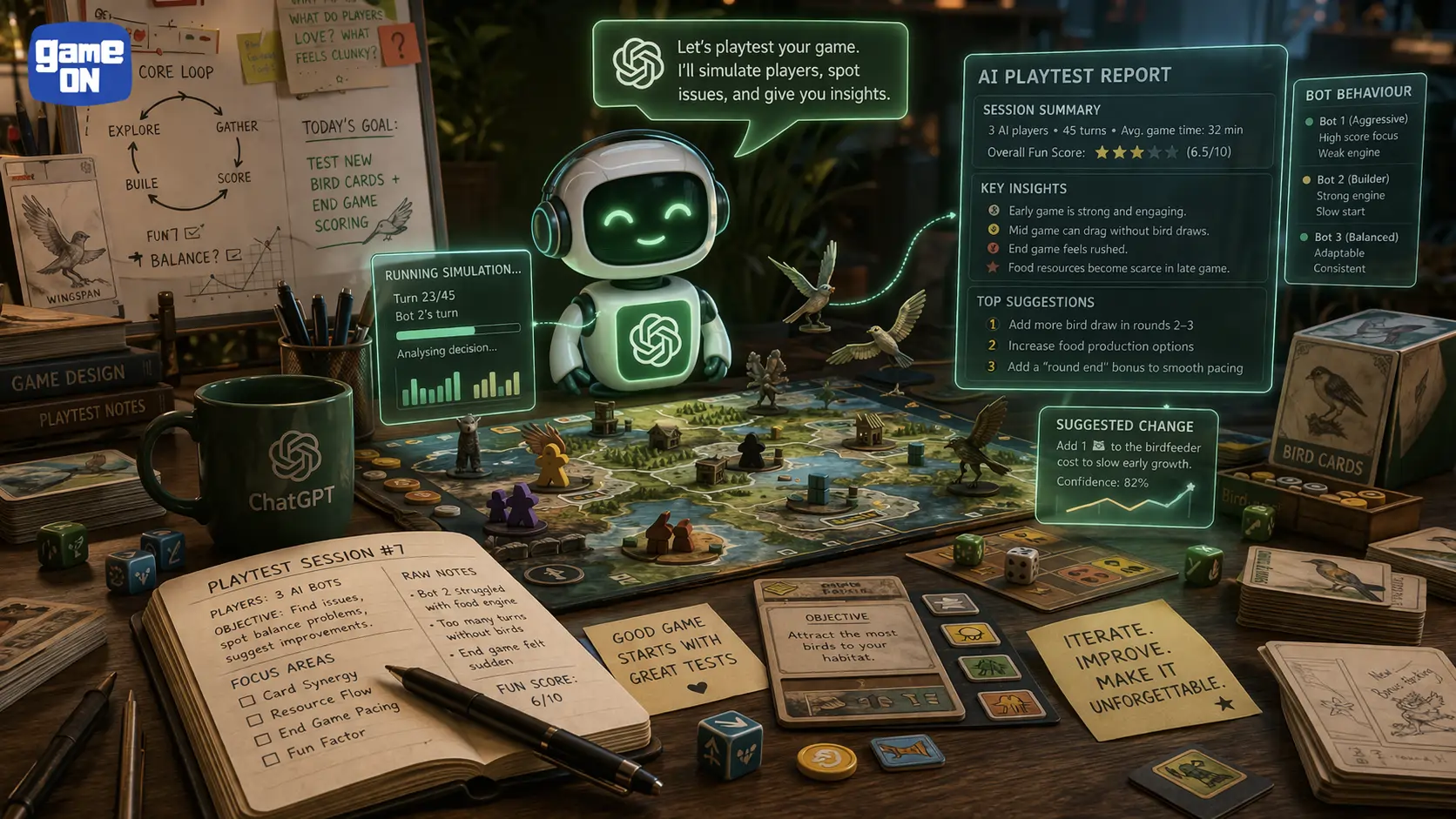
Every board game designer knows the bottleneck: you need ten hours of playtesting and six willing humans, and you need them before your idea falls apart on the table. ChatGPT can be your first playtester, available at midnight, never bored, and brutally honest about broken mechanics.
What Is AI Playtesting?
AI playtesting means feeding your game rules, mechanics, and design goals into an AI language model and asking it to simulate how a player would experience them. The model reasons through your rulebook, probes edge cases, spots ambiguity, and predicts where frustration or imbalance is likely to emerge. It cannot roll physical dice or feel the tension of a close game, but it can do in seconds what a human reader takes an evening to do: interrogate every rule for consistency and fairness.
The skill behind this is prompt engineering. The more precisely you describe your game’s mechanics, player count, intended experience, and design goals, the richer and more actionable the feedback you receive.
Agricola: Stress-Testing a Worker-Placement Variant
Say you are designing a variant of Agricola where players can share action spaces by paying a grain tax. You type your three-paragraph rule into ChatGPT and ask it to play through rounds 1 to 3 as both a solo player and a two-player game. ChatGPT immediately flags that the grain tax creates a runaway leader problem: the player who collects grain first can always afford to share spaces, locking out opponents from key spots. It suggests two fixes: a sliding tax that increases with each use, or a shared-tax pool that benefits all players equally.
In five minutes, you have balance feedback that would have taken two full playtesting sessions to surface. You also discover a rules ambiguity: your text says “pay before placing,” but does that mean before choosing the space or before placing the worker? ChatGPT catches it because you asked it to read the rules as a first-time player.
Why This Matters Beyond Board Games
The skill of using AI to simulate user experience and catch flaws before launch is one of the most transferable abilities in modern work. Educators can describe a lesson plan and ask ChatGPT to roleplay as a confused student, surfacing gaps before the class begins. Entrepreneurs can outline a product workflow and ask the model to act as a frustrated first-time user, identifying where drop-off will happen. In software development, developers feed feature specs to AI models to find logical contradictions before a line of code is written.
The underlying habit is the same everywhere: build a feedback loop before you invest deeply. AI gives you that loop cheaply, repeatedly, and at any hour. Teams that learn to use it this way ship better products, design clearer learning experiences, and waste far less time on rework.
Your Turn: Try It Right Now
Open ChatGPT and paste one of these prompts. The more detail you give about your game, the sharper the feedback you will receive.
Your first step today
Open ChatGPT and paste this — replacing the bracketed sections with your own game details:
You are an expert board game designer and playtester. I am designing a worker-placement game for 2–4 players. Here are the core rules: [Paste your rules here — action spaces, resource types, turn structure, win condition] Please do the following: 1. Play through rounds 1 and 2 as a solo player, narrating your decisions. 2. Identify any rule ambiguities that would confuse a first-time player. 3. Flag any mechanics that could create a runaway leader or a catch-up problem. 4. Suggest one specific change to improve balance. Be specific and critical. Treat this as a professional playtesting report.
Go further - Educators & Classroom Designers
Use ChatGPT to test a learning activity the same way you would test a game:
Act as a secondary school student aged 14 with no prior knowledge of [your topic]. I am going to describe a classroom activity. Read the instructions as that student and then: 1. Identify every point where you would feel confused or lost. 2. List any instructions that are ambiguous or could be interpreted in two different ways. 3. Predict which step is most likely to cause the group to go off-track. 4. Suggest one change to the instructions that would make the activity clearer. Here are the activity instructions: [paste your activity description]
Go further - Entrepreneurs & Product Builders
Stress-test a product or service flow before you build it:
You are a sceptical first-time customer encountering my product for the first time. I will describe the user journey step by step. As you read each step: 1. Note any moment where you would hesitate, feel confused, or consider dropping off. 2. Identify any claim or instruction that feels unclear or untrustworthy. 3. List the three most likely reasons a customer would abandon the process. 4. Recommend one change to the journey that would most increase completion rate. Here is my user journey: [describe your onboarding, checkout, or service flow]