
After The Grail, Prison Island, MindMaze and Albi, the fifth activity in our PlayQuest journey took us outside Prague to Dobříš. This time, the challenge was different: instead of simply playing, testing or learning about games, participants were going to start creating their own.
The activity focused on AI board game design and how artificial intelligence and other digital tools can support the journey from a first idea to a playable prototype.
A warm welcome in Dobříš
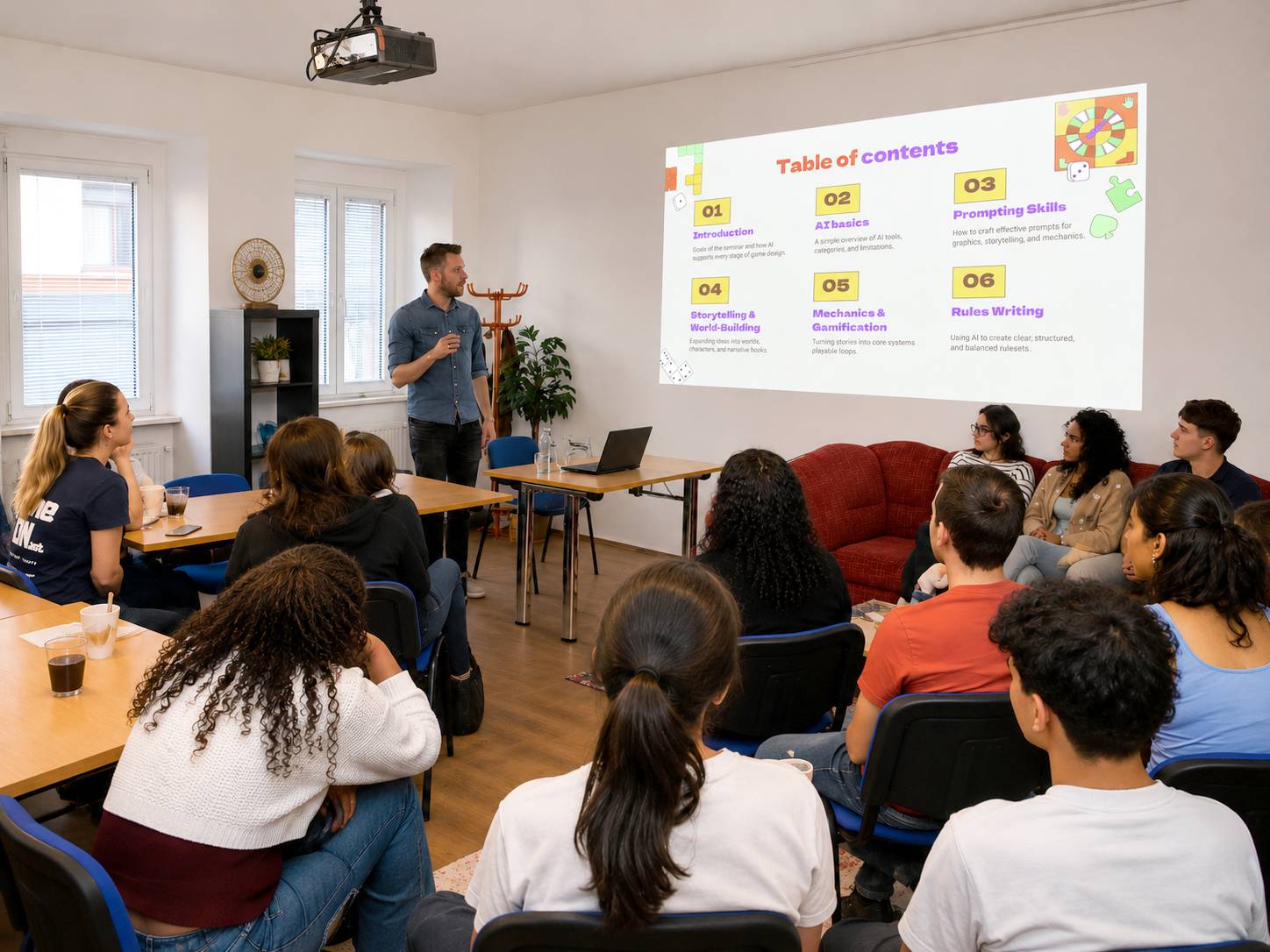
The activity took place at Klubkavárna Coolna in Dobříš, where participants came together for an afternoon focused on artificial intelligence, creativity and board game development.
Our visit also included a warm welcome from the Mayor of Dobříš, Jindriska Romba at the town community centre. She expressed her appreciation that the local youth centre was among the beneficiaries of the GameOn board games library in Czechia, helping make games more accessible to young people in the local community.
From AI basics to creating a board game
The main workshop was delivered by Michal Mujgoš, a marketing and business expert with more than 20 years experience and a track record of supporting over 1,000 entrepreneurs.
For PlayQuest, Michal prepared a workshop specifically focused on AI and board game development. It started with the basics: understanding different types of AI tools, their possibilities and limitations, and learning how better prompts can produce better results. Participants explored how giving AI a clear goal, enough context, specific constraints and a desired output format can completely change the quality of its response.
But the session quickly moved from theory to practice. Participants followed the board game development process step by step, exploring how AI could help with idea generation, storytelling and world-building, game mechanics and gamification, rules writing, generating content and visual concepts, and finally testing and balancing a game. Importantly, the message was not that AI should replace creativity. Instead, it can help develop ideas faster, explore alternatives and make prototyping easier.
Explore the workshop presentation
Browse Michal Mujgoš’ AI + Board Games: From Idea to Prototype presentation, covering prompting, storytelling, mechanics, rules, visual creation, prototyping, testing and balancing.
Learning by creating
Participants then split into teams and started experimenting with prompts themselves.
An initial idea could become a setting and story. That story could be turned into a game loop. Mechanics could be compared and improved. Rules could be drafted, questioned and rewritten. Cards, characters and visual concepts could be imagined, while AI could even be asked to simulate parts of a playtest and identify possible problems.
By the end of the session, each team had created its own board game prototype on paper.
The objective was never to ask AI to simply “make a game”. Participants still had to discuss, choose, reject ideas, solve problems and decide what would actually be fun to play. AI became another tool in the creative process.
And one prototype did not stay on paper
One of the ideas developed during this activity became particularly important.
A prototype first created by participants in Dobříš provided the starting point for Erasmus Unleashed, the board game that was later further developed, tested and produced by participants as one of the outcomes of the GameOn project.
What began with a few ideas, prompts and sheets of paper eventually became a real board game.
That makes the Dobříš activity an important part of our PlayQuest story. After experiencing different games, puzzles and the professional board game industry, participants were now beginning to put everything they had learned into practice — and create something of their own.