
In Prague, PlayQuest participants did much more than play games and visit interesting venues. They were challenged to look behind each experience: How does the idea work? What value does it create? Could it solve a social need? And could something similar work back home?
That entrepreneurial way of thinking was an important part of GameChangers from the very beginning.
The project set out to introduce young people not only to board games, game design and new technologies, but also to entrepreneurship and social entrepreneurship — using real experiences rather than classroom theory.
Why entrepreneurship?
When GameChangers was being developed, European research highlighted an interesting gap.
Many young people were interested in working for themselves, yet comparatively few were familiar with the idea of social entrepreneurship — building a sustainable activity or business while deliberately creating positive social impact.
Interest is high. Familiarity is low.
The figures that helped shape the entrepreneurial strand of GameChangers.
🇲🇹 Malta
🇨🇿 Czechia
Source: Flash Eurobarometer on Social Entrepreneurship and Youth (2022), figures cited in the GameChangers application.
PlayQuest therefore offered an opportunity to make entrepreneurship much more tangible.
Rather than starting with business terminology, participants experienced real concepts first.
They played. They explored. They asked questions. And then they reflected.
Looking at games through a different lens
During the five-day PlayQuest programme in Prague, young people from Malta and Czechia experienced different parts of the games ecosystem — from interactive challenge venues and city puzzle experiences to game design, specialist retail and community gaming spaces.
But an enjoyable experience was only the beginning.
After activities, participants completed structured reflection forms encouraging them to think beyond “Did I enjoy this?”
They were asked to consider questions such as:
What makes this concept interesting?
What social value could it provide?
What problem in the community could it help address?
Could the concept work somewhere else?
What would need to change?
Could technology or AI improve the idea?
What new opportunities could be created around it?
For the Maltese participants, one question became particularly important:
Could something like this work in Malta?
The PlayQuest Entrepreneurship Lens
Every experience could become a small case study.
Try the concept for yourself.
Understand what makes the idea work.
What need or problem could it address?
Could it work in Malta or Czechia?
What could this become?
This transformed each experience into a small, practical entrepreneurship case study.
Participants were not being asked to write formal business plans. Instead, they were learning one of the most important entrepreneurial habits: looking at something that already exists and asking what else it could become.
So, could these ideas work in Malta?
Four of the PlayQuest venue experiences produced directly comparable ratings from Maltese participants, using a five-point scale:
1 — No potential for Malta
2 — Unlikely as it is
3 — Possible with adaptation
4 — Good potential
5 — Definitely bring it to Malta
The results were deliberately not unanimous, and that matters!
Entrepreneurial thinking does not mean becoming enthusiastic about every idea. It also means recognising barriers, questioning assumptions and deciding when an otherwise good concept may need substantial adaptation.
Could this work in Malta?
Maltese participants rated the potential for each concept to operate as a social enterprise in Malta.
These are participant assessments, not formal commercial feasibility studies. Tlama Games is not included because it was visited by the Czech group only and therefore received no Malta rating.
Prison Island — 4.50 / 5
Prison Island generated the strongest Malta rating.
Participants saw potential in the combination of physical activity, problem-solving, teamwork and different challenge types. Importantly, they did not simply suggest copying the Prague venue.
They imagined smaller versions suitable for Malta, challenges inspired by Maltese history and culture, different difficulty levels, school programmes and experiences designed to help people who do not already know each other connect through teamwork.
The potential social value was also clear: an active alternative to screen time, a space for teenagers and young adults, opportunities to practise resilience and collaboration, and activities where different strengths could contribute to the success of a team.
MindMaze — 3.75 / 5
The outdoor puzzle experience prompted a different type of entrepreneurial thinking.
Participants immediately connected the concept with Malta’s own cultural and historical environment.
Could Valletta become the game board? What about Mdina or Vittoriosa?
They imagined interactive routes based on real history, architecture and folklore, potentially combining education, tourism, physical activity and puzzle-solving.
The concept also prompted discussion around partnerships with schools, youth organisations and cultural institutions.
In other words, participants were not simply transferring a product from one country to another. They were rebuilding the concept around local assets.
Albi — 3.50 / 5
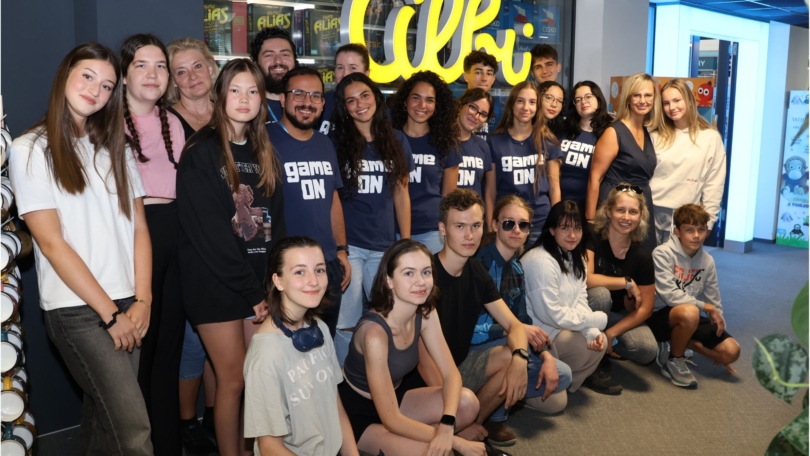
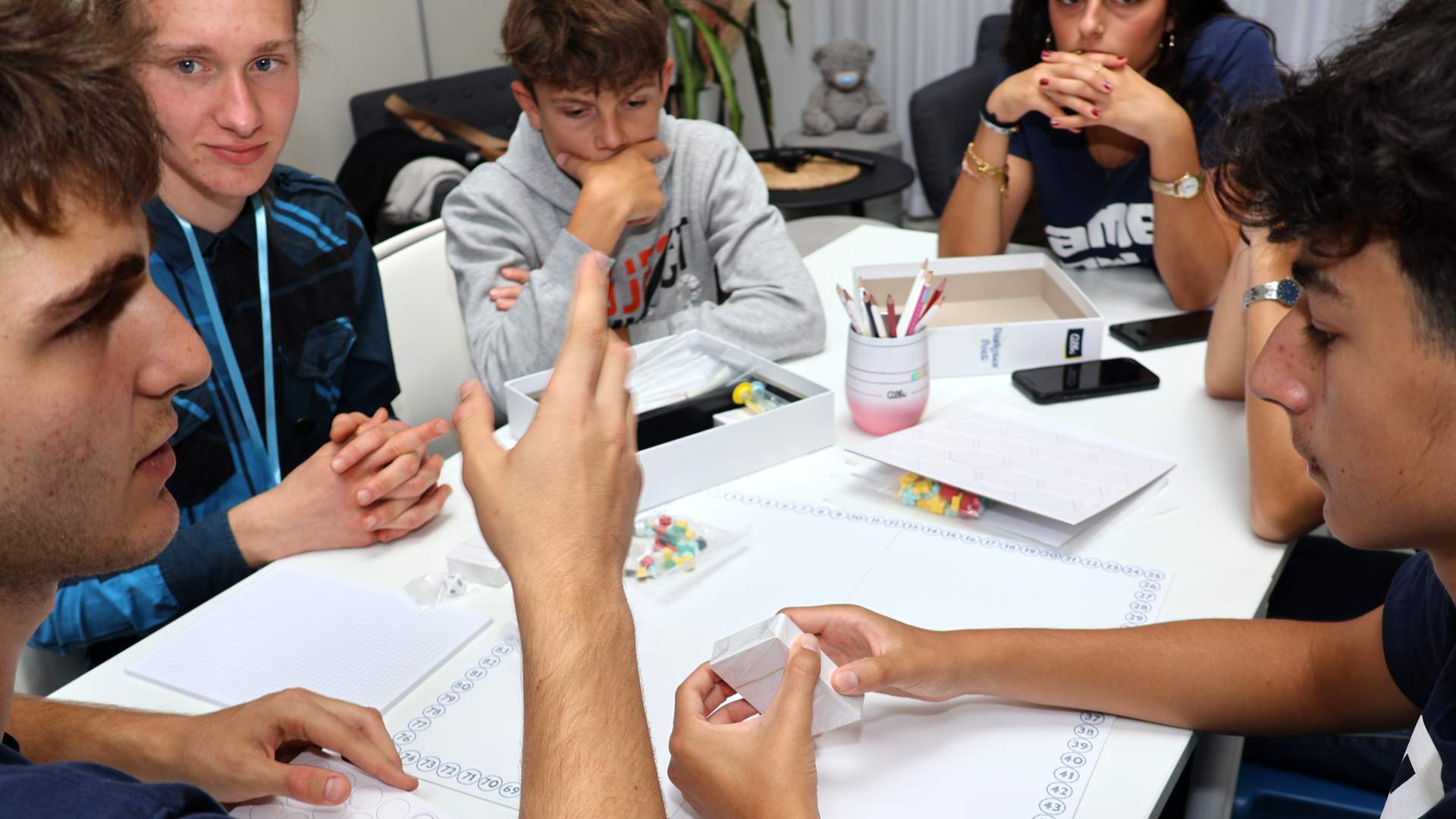
At Albi, participants moved from playing games to creating them.
Working from an initial idea towards a prototype gave them an insight into how much creativity, negotiation, testing and decision-making sits behind even a seemingly simple game.
The Malta adaptations proposed included game-design workshops for schools and youth organisations, locally themed board games, cooperation with Maltese game creators and programmes using game creation as a route into entrepreneurship.
This was particularly relevant to GameChangers because it connected creativity with something more practical:
an idea can become a product.
The Grail — 3.10 / 5
The Grail produced one of the most interesting results precisely because its Malta rating was lower.
Participants clearly recognised the social value of a welcoming board-game community space. They identified benefits including meeting new people, reducing social isolation, providing an activity-based environment for people who find conventional social situations difficult, and creating a place where people can spend time together.
But they also identified practical Maltese barriers: property costs, limited space, the size of the local market and the challenge of building a sufficiently large gaming community around a permanent venue.
Their response was therefore not: “This is a bad idea.”
It was: “This is valuable — but the model would need to change.”
That distinction is entrepreneurship.
From Czechia to Malta
Tap a concept to explore the social-impact ideas identified by Czech participants and the local adaptations proposed by Maltese participants.
Prison Island
4.50 / 5
Physical & mental challenge arena
🇨🇿 Social-impact ideas
- Lower-cost access for low-income families.
- Mental-health and wellbeing partnerships.
- Employment opportunities for people with fewer opportunities.
- More accessible challenge formats for people with disabilities.
🇲🇹 Malta adaptations
- Smaller-scale challenge spaces.
- Rooms inspired by Maltese history, geography and culture.
- Different difficulty levels for schools, families and adults.
- Use team formation as a way to connect people who do not already know one another.
MindMaze
3.75 / 5
Outdoor city puzzle experience
🇨🇿 Social-impact ideas
- Subsidised versions for school groups.
- Accessible routes for people with mobility challenges.
- Use revenue to support heritage or urban-art initiatives.
- Train young people as puzzle designers.
🇲🇹 Malta adaptations
- Create puzzle routes through Valletta, Mdina or Vittoriosa.
- Use genuine local history, folklore and architecture.
- Partner with schools and cultural institutions.
- Develop multilingual versions for local and visitor audiences.
Albi
3.50 / 5
Game design & creative entrepreneurship
🇨🇿 Social-impact ideas
- Discounted workshops for low-income young people.
- Training and employment pathways in game design.
- Creative-making programmes linked to wellbeing.
- Commercial activity helping to fund free community sessions.
🇲🇹 Malta adaptations
- “Design Your Own Maltese Board Game” workshops.
- Partnerships with schools and youth organisations.
- Connect participants with local game creators.
- Use workshops as a pathway into entrepreneurship.
The Grail
3.10 / 5
Board-game café & community space
🇨🇿 Social-impact ideas
- Build on the social value of free entry.
- Improve disability access.
- Create mental-health and loneliness-focused events.
- Develop employment pathways for people with fewer opportunities.
🇲🇹 Malta adaptations
- Regular themed gaming evenings instead of immediately creating a permanent venue.
- Free or minimal entry supported by food, drinks or game sales.
- Use outdoor areas during warmer months.
- Design activities specifically for people attending alone.
Social entrepreneurship asks another question
A conventional business question might be:
Can this make money?
Social entrepreneurship adds another:
What positive change could this create?
Across the feedback, participants repeatedly identified ways game-based businesses could contribute to their communities.
They considered:
affordable access for young people and low-income families;
safe and welcoming social spaces;
reducing isolation and excessive screen time;
activities supporting mental wellbeing;
employment and skills-development opportunities;
accessibility for people with disabilities;
youth and school programmes;
cultural and heritage education;
opportunities for young people to develop creative and entrepreneurial skills.
Czech participants approached the same experiences from their own perspective.
Their suggestions included subsidised access, employment pathways for people with fewer opportunities, accessible activities, mental-health partnerships, community programmes and using commercial income to support social initiatives.
This was an important part of the learning process.
Participants were not being asked simply to identify businesses they liked.
They were being asked to imagine how a business model could generate greater social value.
A good idea does not have to be copied
One of the strongest lessons from PlayQuest was that entrepreneurship is not necessarily about inventing something completely new.
Innovation can also mean:
seeing an existing idea, understanding why it works and adapting it intelligently to a different context.
A puzzle trail through Prague cannot simply be transported to Malta.
But the underlying model can inspire a completely different experience built around Valletta, Mdina or the Three Cities.
A large indoor challenge arena might not be practical in exactly the same format.
But its combination of physical activity, teamwork, puzzles and progression could inspire something smaller and locally themed.
A Czech board-game community space might face commercial challenges in Malta.
But elements of the idea could appear through pop-up events, monthly gaming evenings, school partnerships or shared community spaces.
The question becomes less:
“Can we copy this?”
and more:
“What is the valuable part of this idea — and how could we rebuild it for our community?”
That is a much more useful entrepreneurial question.
Where does AI fit?
Participants were also asked whether AI tools could help create or improve experiences like the ones they had just encountered.
This was not intended as a test of whether every business should use AI.
It was another innovation exercise.
Could AI help with brainstorming? Puzzle creation? Story development? Personalisation? Game design? Marketing? Accessibility?
Or would technology actually weaken what makes an experience special?
The responses varied considerably.
Albi’s game-design workshop produced particularly strong enthusiasm for AI, while highly physical or community-driven experiences generated far more cautious responses.
Tlama Games provided an especially interesting counterpoint: among its Czech participants, most felt that AI would add little to an experience whose value came from physical games, specialist knowledge, tactile discovery and human community.
Could AI help improve an activity like this?
Participants were encouraged to consider where AI might add value — and where the human experience mattered more.
Being able to say “No, technology does not improve this” can be just as valuable as identifying an innovative new use for it.
Critical thinking means understanding both possibilities and limits.
What were participants really practising?
Behind the games and activities, PlayQuest was developing a wider set of entrepreneurial behaviours.
Participants had to:
Observe
Look beyond the surface of an experience and understand what made it work.
Question
Identify strengths, weaknesses and assumptions.
Connect
Relate an idea to real needs in another community.
Adapt
Think about how culture, location, costs, audiences and resources could change a concept.
Create
Generate alternatives rather than simply accepting what already exists.
Evaluate
Decide whether an idea had potential — and explain why.
These are useful skills whether or not a participant eventually starts a business.
They are also valuable in employment, community initiatives, youth projects and everyday problem-solving.
From playing games to seeing possibilities
PlayQuest was never intended to turn a group of young people into entrepreneurs in five days.
Its purpose was more fundamental.
It gave participants an opportunity to experience entrepreneurship rather than simply hear about it.
A game café became a discussion about community spaces.
A puzzle trail became an idea for cultural tourism.
A challenge arena became a conversation about youth activity, inclusion and teamwork.
A game-design workshop became an insight into how creative ideas move towards real products.
And a question repeated throughout the programme encouraged participants to look at familiar things differently:
Could this work where I live?
Sometimes the answer was yes.
Sometimes it was maybe.
Sometimes the answer depended completely on changing the idea.
But learning how to ask the question — and how to think seriously about the answer — was the real result.
About the feedback
The complete PlayQuest evaluation brings together 148 responses across eight activities and establishments from 21 young people participating in the five-day Prague programme.
Reflection forms explored participants’ experiences, skills, ideas for AI-supported innovation and social-enterprise thinking. Maltese participants were also asked to rate how strongly selected concepts could work as social enterprises in Malta.
The ratings presented here represent participants’ perceptions after experiencing each activity. They are not formal market-feasibility studies. Their value lies in showing how young people analysed existing concepts, identified social needs and generated ideas for adapting them to another community.
The complete feedback report provides a more detailed breakdown of responses, participant comments and recommendations.